Monday, December 7, 2015
DreamChaser PMU Horse Rescue and Rehabilitation Social Media Campaign
Here is a project I worked on for DreamChaser Horse Rescue and Rehabilitation

Saturday, December 5, 2015
Choosing a Career Coach or Guidance Counselor
Maybe you have exhausted all your ideas in solving your existential crisis or repeatedly failing job hunt. Another way to find what you're doing next with your life is to find a career coach (counselor or guide). Career coaches can help you find your dream job.

In order to find a career counselor,

In order to find a career counselor,
1. Ask friends if they have ever used a career counselor and have suggestions
2. Try the telephone book ( Ancient, I know)
3. Use the internet, google search career counselors in your area.
4. Your college or university's career center (This one might actually be free to students and Alumni!)
Important Questions to ask include
Important Questions to ask include
- What is your program?
- Who will be counseling? What is their experience?
- Do you have a sucess rate?
- What is the cost for this service?
- Is there a contract? (please, take it home and read it. Do NOT blindly sign)
Also, fair warning that "Pay me first" packages tend to be a scam. I have not had experience with any of them, but reading the fine print is important!
If you're frustrated, I guarantee it won't hurt to investigate career coaching and job counseling.
If you're frustrated, I guarantee it won't hurt to investigate career coaching and job counseling.
Wednesday, December 2, 2015
Dealing with your Feelings while hunting for work
The job search can be a trying time. It's easy to be full of anxiety and nervousness while trying to figure out what job you will do next. It gets even worse when money is tight and it feels like no end is in site. The longer the job hunt goes on, the less money is available for use. Feelings of unhappiness, hopelessness, and depression are common. It is very important to deal with these feelings. Richard Bolles, the author of What Color is your Parachute offers a few suggestions for dealing with one's feelings while unemployed.


- Get enough sleep! If you are not getting enough rest, your body is not functioning all that well. I know this sounds hypocritical coming from a college student nearing finals week. What it comes down to is that you will feel better if you get enough sleep
- Live a healthy lifestyle! This includes regular exercise, drinking plenty of water, reducing sugars, and eating a healthy and balanced diet.
- Change the physical surroundings around you. Many believe that your physical surroundings reflect how you feel. If they are a messy disaster, you likely will feel like a mess and anxious disaster.
- Get out! ( No literally, go outside and enjoy nature daily!)
- Focus on other people and their problems. Try volunteering at a place that interests you where you can also help others. Examples include a food bank, a hospital, or an animal shelter.
- Go on mini adventures! Explore the area you live in. Find places you've never been and enjoy them. This will give you a break from obsessing about your unemployment.
- Expand your mental horizons! Learn to better understand your brain to help heal. If that does not interest you, learn something new that sounds interesting to you. Did you want to play an instrument as a child? Never got around to it? Try it!
- Talk to people! Particularly relatives and close friends to release your pent up feelings. This will help you gain power over your feelings.
- Get angry! Go the gym or even use your pillows as a punching bag. This will help you get some of your anger and frustration out.
- Keep a gratitude journal. Make a daily list of things you're grateful for. This will help you stop brooding about what is wrong and instead, think about the precious gifts we have.
Keep your head up, the job hunt will eventually end. The feelings are hard to deal with now, but they will be replaced with different feelings when you finally get the job. All of these recommendations are still good recommendations for when you land a job.
Tuesday, November 24, 2015
Do you have a mission?
To find one's mission in life, a person must define what is unique about them.
Our mission can guide us, telling us who we are, what we want to do, and what we plan to do in the future. By following your mission you are being something as opposed to just doing things. Having a mission can help one decide what he or she is going to do with his or her time. What is he or she going to accomplish in his or her life? This sounds great, but what on earth are the parameters for an individual or a companies mission statement?
 Some things to remember about finding ones mission
Our mission can guide us, telling us who we are, what we want to do, and what we plan to do in the future. By following your mission you are being something as opposed to just doing things. Having a mission can help one decide what he or she is going to do with his or her time. What is he or she going to accomplish in his or her life? This sounds great, but what on earth are the parameters for an individual or a companies mission statement?

- Your mission exists in your daily life, you just need to find it!
- Your mission improves the human race is some way of another.
- Your mission will be strengthened by using your talents to complete it, in places that are appealing and interesting to you, and will fill a gap society lacks.
Denise Morrison, the CEO of Campbell's soup, defines her mission statement as follows: She hopes "To serve as a leader, live a balanced life, and apply ethical principles to make a significant difference."
Her mission statement fits all of the parameters mentioned above, it's something that relates to her daily life, improves the world through her management of her Campbell's soup company, and it dictates her decisions.
It'll likely take time to create a mission statement that you full-heartedly support, but understanding yourself and your goals enough to have a mission statement will guide your future. Don't worry if it's not as short and concise as Denise Morrison's mission statement.
Her mission statement fits all of the parameters mentioned above, it's something that relates to her daily life, improves the world through her management of her Campbell's soup company, and it dictates her decisions.
It'll likely take time to create a mission statement that you full-heartedly support, but understanding yourself and your goals enough to have a mission statement will guide your future. Don't worry if it's not as short and concise as Denise Morrison's mission statement.
Thursday, November 19, 2015
You Could Be Your Own Boss
It's not easy and there are a lot of ways to fail. Here are some tips to become a successful entrepreneur.
1. Write
Write to figure out who you are and what you want to do. Look at (or create your resume) and find out what skills you already posses, what things you like, and how you can combine these skills and interest to get paid!
2. Read
Learn all you can about running your own business by reading. The author suggests a few places to look into including Daniel Pink's "Free Agent," workingsolo.com, Small Business Administration, A Small Business Expert, Business Owners' Toolkit, Business Owners' Idea Cafe, Nolo's Business. LLC
3. Explore
Interview and look into others who have started a similar business, find out their mistakes and challenges. You need to figure out what skills, knowledge, and experience you have, what skills, knowledge, and experience you need, and finally what skills knowledge and experience you lack that is required for your business.
4. Get Feedback
Workingsolo.com and checkster.com are websites that ask the hard questions of whether you're cut out to run your own business. Ultimately, you should discuss your plan with people who are important to you and close to you and see how they feel about it.
In the end, if you decide you do indeed want to be an entrepreneur, know that this involves some risk and that having a plan B if your plan doesn't work is very important. Have a plan b drawn out before you even start your initial plan!
Best of luck!

1. Write
Write to figure out who you are and what you want to do. Look at (or create your resume) and find out what skills you already posses, what things you like, and how you can combine these skills and interest to get paid!
2. Read
Learn all you can about running your own business by reading. The author suggests a few places to look into including Daniel Pink's "Free Agent," workingsolo.com, Small Business Administration, A Small Business Expert, Business Owners' Toolkit, Business Owners' Idea Cafe, Nolo's Business. LLC
3. Explore
Interview and look into others who have started a similar business, find out their mistakes and challenges. You need to figure out what skills, knowledge, and experience you have, what skills, knowledge, and experience you need, and finally what skills knowledge and experience you lack that is required for your business.
4. Get Feedback
Workingsolo.com and checkster.com are websites that ask the hard questions of whether you're cut out to run your own business. Ultimately, you should discuss your plan with people who are important to you and close to you and see how they feel about it.
In the end, if you decide you do indeed want to be an entrepreneur, know that this involves some risk and that having a plan B if your plan doesn't work is very important. Have a plan b drawn out before you even start your initial plan!
Best of luck!

Monday, November 16, 2015
Finding a Career
Let's face it, in a world full of distractions, obligations, and complex long term decisions, it's hard to decide what to do with your time.
Do I go to grad school? Do I enter the work force? Should I become a doctor? Will I have financial security? Will I enjoy what career I choose?
In Richard Bolles' book What Color Is Your Parachute? He discusses the numerous way people decide on a career to pursue.
Some ways to explore possible careers include
1. Looking all around the black hole we call the Internet. Sources like the occupation outlook handbook provide information about employment rate of jobs.
2. Through tests that analyze personality and interests like the Dr.Holland's Self Directed Search. The problem with tests is that they sometimes limit people too much to thinking that they have to pursue 1 specific career. The reality is that these tests should provide ideas as to what to do next.
3. Bolles' flower method which analyzes different aspect of one's life, aspirations, and current abilities to find a dream career.
4. Changing careers in two steps by changing both he field and job you have to what you want. By doing this in two steps you gain experience in the field before getting your dream job.
5. Choosing a job based on what the job market currently needs by looking at projections of future "hot jobs.
The moral of the story is that multiple methods can help decide what career to persue d how to get there. The adventure is trying the different method and finding a career that interstests you.
Do I go to grad school? Do I enter the work force? Should I become a doctor? Will I have financial security? Will I enjoy what career I choose?
In Richard Bolles' book What Color Is Your Parachute? He discusses the numerous way people decide on a career to pursue.
Some ways to explore possible careers include
1. Looking all around the black hole we call the Internet. Sources like the occupation outlook handbook provide information about employment rate of jobs.
2. Through tests that analyze personality and interests like the Dr.Holland's Self Directed Search. The problem with tests is that they sometimes limit people too much to thinking that they have to pursue 1 specific career. The reality is that these tests should provide ideas as to what to do next.
3. Bolles' flower method which analyzes different aspect of one's life, aspirations, and current abilities to find a dream career.
4. Changing careers in two steps by changing both he field and job you have to what you want. By doing this in two steps you gain experience in the field before getting your dream job.
5. Choosing a job based on what the job market currently needs by looking at projections of future "hot jobs.
The moral of the story is that multiple methods can help decide what career to persue d how to get there. The adventure is trying the different method and finding a career that interstests you.
Thursday, November 5, 2015
Everyone has Handicaps and Dragons
Have you ever met that person that seems like they have everything figured out? They know exactly what they want to do, where they want to be in 5 years, and have the perfect balance of work and play. It seems like there is absolutely nothing that can slow them down.
This sounds great, but does not realistically represent people. People are full of doubt and insecurities. Sometimes we find success, but we still feel like importers.
Handicaps can be physical disabilities, but they do not necessarily have to be.
This sounds great, but does not realistically represent people. People are full of doubt and insecurities. Sometimes we find success, but we still feel like importers.
Handicaps can be physical disabilities, but they do not necessarily have to be.
Some examples include
- I am physically limited and cannot perform certain tasks ( a physical handicap)
- feeling like you lack experience or qualifications
- I don't have the right degree
- I don't fit the "look"
- I'm too young and inexperienced
- I'm too old
- I'm too shy
The best way to approach a handicap is not to treat it as something that is limiting you. Instead, have a positive attitude towards it. This handicap is adding to your charm.


Keep a positive attitude, and do not let dragons prevent you from pursuing a job, a career, or even just an interest.
Tuesday, November 3, 2015
Exploring Careers
In Chapter 8 of What Color Is your Parachute, Bolles discusses finding a job that overlaps with one's interests.
The reality, is that finding a job that overlaps with your interest is not always easy. It also can be scary to make the decision of pursuing one job or the other. There seems to always be a slight sinking feeling that you're missing something by picking one career choice or the other. The hardest part, perhaps is where does one even begin? Do you go left, right, forward? What decisions do you make? It begins to feel a lot like being stuck in a corn maze, but a really large corn maze with no end in sight.
My best advice to the chronic existential is explore your options. Talk to people in the fields you're interested in and get their takes. This will also give you a better understanding of what the jobs your interested in entail and make you a more prepared interview candidate and job seeker.

To find out more about a company and feel less stuck in a maze,
- Read published materials from an organization be it from a website or in print
- Look for people to talk to at the organization or similar organizations.
- Look on the internet! Be wary, as I'm sure you know, the internet is vast and full of information.
- The author suggests www.Glassdoor.com, which contains reviews of companies.
- Try a temp agency
- www.Rateatemp.com is a temp agency directory
- Volunteer
Finding a career takes time and not letting the frustration get to you is very important. Keep exploring!
Social Listening
As I have previously mentioned, it's important to get content out onto social media. It is also important to monitor social media and listen to what people are saying. By listening to social media, you can find out what people are saying about a brand, gauge the health of a brand online, analyze and track a brand, and identify conversations of crisis about a brand.
Perhaps the most important reason to monitor social media is to catch a crisis early. Thanks to the internet and social media, a crisis can escalate out of control in just a matter of a few hours.
Ignoring social media, especially during a PR crisis can lead to large losses for a company. In 2013, Target loss favor of many customers because it did not act very quickly when their data on customers was breached.
Even two years later, in 2015, target still has a very extensive FAQs page about the breach on their corporate website.

PR Crisis are going to happen, but companies can reduce their effects by monitoring social media. The time to respond to a crisis is reduced, but customers also have acess to a company though the internet. The best way to combat a PR crisis is to admit to the mistake, formulate a plan, and then tell consumers what you plan to do.
The types of media concerned with social media monitoring and listening is
- Owned media includes social media pages that your company controls, like Facebook, Twitter, a blog, or company website.
- Earned media is media that comes from people starting conversations, it's everything else that is not company owned and operated.
Tools that can be used to monitor social media include Omniture, Google Analytics, Facebook Insights, Radian 6,
Perhaps the most important reason to monitor social media is to catch a crisis early. Thanks to the internet and social media, a crisis can escalate out of control in just a matter of a few hours.
Ignoring social media, especially during a PR crisis can lead to large losses for a company. In 2013, Target loss favor of many customers because it did not act very quickly when their data on customers was breached.
Even two years later, in 2015, target still has a very extensive FAQs page about the breach on their corporate website.

PR Crisis are going to happen, but companies can reduce their effects by monitoring social media. The time to respond to a crisis is reduced, but customers also have acess to a company though the internet. The best way to combat a PR crisis is to admit to the mistake, formulate a plan, and then tell consumers what you plan to do.
Thursday, October 22, 2015
My First posts using Hootsuite
In my previous post, I discussed using Hootsuite to post to multiple social media websites. I thought I posted the post, but I'm realizing now that I forgot to actually click schedule.
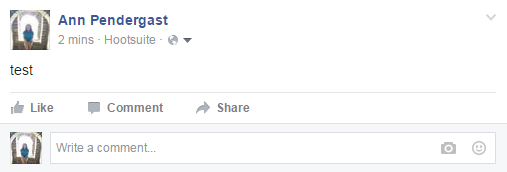
So this is my take two attempt. For this one, I wrote "test" into the post box and instead of scheduling the post, I posted immediately by hitting "send now" option.
Here are the results:
Facebook Post
Twitter Post

LinkedIn Post

To view a post on Linkedin, you have to hover over "profile" at the top, then scroll down to "your updates."
I have to play around with Hootsuite to become more efficient and proficient at it, but I made my first post! The biggest benefit is time and effort saved when you post to multiple websites at once. You do not have to log in to 3+ social media sites to post, you just need to connect them to your hootsuite and then Viola, you can post!
Tuesday, October 20, 2015
Using Hootsuite to post to multiple Social Media Sites
Hootsuite can act as a hub for all on one's social media accounts. This can also work really well for a company's for that matter. Users can post content to multiple social networks at once and schedule ahead of time to post.

This screenshot from Hootsuite.com shows what the free Hootsuite account includes
For example, I linked my Facebook account, my LinkedIn, and my twitter to my LinkedIn.


This screenshot from Hootsuite.com shows what the free Hootsuite account includes
The free version allows you to post on up to three social media networks at once. At any time however, you get to choose which social networks are posting content.
For example, I linked my Facebook account, my LinkedIn, and my twitter to my LinkedIn.
In addition, you can track various aspects on Social media. For example, I created a stream that allows me to track anytime my username "AnnieP122" comes up on twitter. I do not have a large presence on Twitter, but here's an example of a post that appeared in my twitter stream for my username.
What I am looking forward to most is the ability to schedule posts. Content can be created in advance and then scheduled to be posted in the future. This way you can schedule a post marking the 25th anniversary gala of an organization you work a month in advanced. In addition you can schedule regular posts leading up and providing more information about the actual 24th anniversary gala creating buzz with limited work and need to constantly remember to post every few days.

Here is my first Hootsuite post. I scheduled it to be posted at 11 am and to be posted to my Facebook and my twitter.
Sunday, October 18, 2015
The Parachute Way of job hunting
The Parachute way is an alternate way to approach the job hunt that is not just writing a resume and cover letter and sending it out into the world. Instead of focusing on the job market, you think about yourself, who you are, and what you most want to do and then find an organization that matches you. I'm a little unsure about this method because it is so different than the traditional job hunting method.
Instead of waiting for the company to have a vacancy, you should approach the company through a person who knows both you and the company, regardless of whether they're actually hiring or not.
It's worth a try in my opinion, even if it's hard to find your true following. You could end up finding a job that you absolutely love for years upon years to come, and that's pretty incredible.

Instead of waiting for the company to have a vacancy, you should approach the company through a person who knows both you and the company, regardless of whether they're actually hiring or not.
It's worth a try in my opinion, even if it's hard to find your true following. You could end up finding a job that you absolutely love for years upon years to come, and that's pretty incredible.
Thursday, October 15, 2015
Achieving Credibility on the internet, Is it all about Aesthetics?
Achieving credibility on the internet is just as complicated than achieving credibility in person. In a way however, achieving credibility between the two are very similar. A Stanford study by Stanford Web Credibility Research found that design of a website had the highest affect on credibility. Aesthetics are very important when it comes to websites. This applies to the real world because if you do not look presentable or like you "fit" whatever job or idea you are presenting, it's much harder to gain an audiences trust. If I saw a person dressed as bozo the clown discussing astrophysics, I would be very confused. Table 1 below shows other parts of a digital website that affect its credibility. The actual content of the website including motive of the company and information are the next important part. In the grand scheme of things, Aesthetics superficially of the website and the way content is presented are important in a consumers experience with a website.

(Fogg et al., 2003).
I think it's worth pointing out that at this point in time, this study is indeed a little dated. I would argue that it is still relevant because the extent to which we use the internet has changed, but we still prefer websites that look clean, professional, have good content, and are easy to read.
If would like to reference the full article,
Tuesday, October 13, 2015
LinkedIn- Yes, It can help you meet people and find a job!
LinkedIn can be applied both to an individual hunting for a job, but also to businesses and brands pushing their products and services. Having a strong individual presence on LinkedIn can also help in establishing a presence for a business or company.
Important things to do on LinkedIn
- build your own network!
- use LinkedIn to aid in finding work
- Create and join LinkedIn groups
- Add examples of projects to expand your LinkedIn portfolio
- make posts and provide updates
Don't abandon your profile on LinkedIn! It's a representation of you and should show your product. If you manage a LinkedIn page for a company, it will likely link to your profile.
One thing to note is that if you're trying to create a LinkedIn profile for a company, you should have an official website and a company e-mail address. LinkedIn also allows for businesses to create advertisements.
The best way to understand LinkedIn is by using it! For that reason, I finally added a profile picture to my LinkedIn and am in the process of updating it and expanding my network.

The best way to keep a LinkedIn account updated and accurate is to schedule time in intervals like once a week for 20 minutes or even 30 minutes a month.
So, go try to make a LinkedIn and see what connections you can find!

A well updated Linkedin should include:
- A summary of who you are
- work experience
- volunteer experience
- Links to projects to create a digital portfolio.
- skills
- connections
- endorsements
So, go try to make a LinkedIn and see what connections you can find!
Monday, October 12, 2015
Advertising on Facebook and Through E-mail
To the people staring at their phones in private and public places,
Cell phone users are everywhere.
Yes, I mean everywhere. I challenge you to walk past a strip mall or restaurants during lunch time and count how many people you see on your cell phones.
A Facebook study found that smartphone users on average spent 2.5 hours every day on their smartphones. The most used application was e-mail followed by Facebook.
I'm not sure how accurate the time spent on smartpohones actually is, but it is important to realize that people are constantly connected to their phones. Smartphones act as alarm clocks, calenders, reminders, a way to communicate quickly, and a way to access the ever growing internet.
That being said reaching potential customers and supporters through Facebook an e-mail can add to a companies marketing campaign.
To reach a company through Facebook, you can make an advertisement for a small cost. Read more about how to do that here. This blog will focus more on the analysis of when one has actually created an add and is beginning to get clicks.

This figure from the ad manager dashboard shows that my advertisement spent its lifetime limit of $5 and ran between Oct 6th- 11th with a focus of clicks per minute. It was also targeted towards the United States, China, and India with a demographic that had interests in social media marketing and social media.

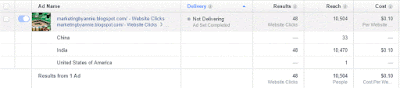
This is a breakdown of the total clicks and reach of my advertisement by age and gender. My add reached and was clicked on mostly by young people between the ages of 13-17 years old and predominately more men clicked on my add than women. I reached 10,504 people, but only 48 of those people actually clicked on the advertisement and followed the link to my website.
The problem with Facebook is that once you create the advertisement and get people to visit your page, you can't really control if your new fans are actually receiving your content. You can however, link a mailing list to your Facebook page or website. If people subscribe to the list, your content will be delivered directly to their e-mail list. MailChimp is a great way to do this. This doesn't necesarily mean a person is reading what you e-mail, but the content is delivered to the person's mailbox.
Cell phone users are everywhere.
Yes, I mean everywhere. I challenge you to walk past a strip mall or restaurants during lunch time and count how many people you see on your cell phones.
A Facebook study found that smartphone users on average spent 2.5 hours every day on their smartphones. The most used application was e-mail followed by Facebook.
I'm not sure how accurate the time spent on smartpohones actually is, but it is important to realize that people are constantly connected to their phones. Smartphones act as alarm clocks, calenders, reminders, a way to communicate quickly, and a way to access the ever growing internet.
That being said reaching potential customers and supporters through Facebook an e-mail can add to a companies marketing campaign.
To reach a company through Facebook, you can make an advertisement for a small cost. Read more about how to do that here. This blog will focus more on the analysis of when one has actually created an add and is beginning to get clicks.

This figure from the ad manager dashboard shows that my advertisement spent its lifetime limit of $5 and ran between Oct 6th- 11th with a focus of clicks per minute. It was also targeted towards the United States, China, and India with a demographic that had interests in social media marketing and social media.


By clicking on breakdown and changing it to by country, I can see that all of my clicks came from India. That is also where my add had the largest reach. I purposely chose to add India and China just to see what would happen. I did not think it would skew my reach so heavily towards India and China. My advertisement only reached one person in the United States. This does show that it is important to tailor your advertisement towards your ideal audience. If you want to reach mainly people in the United States, be careful about adding other countries.
The problem with Facebook is that once you create the advertisement and get people to visit your page, you can't really control if your new fans are actually receiving your content. You can however, link a mailing list to your Facebook page or website. If people subscribe to the list, your content will be delivered directly to their e-mail list. MailChimp is a great way to do this. This doesn't necesarily mean a person is reading what you e-mail, but the content is delivered to the person's mailbox.
Thursday, October 8, 2015
How active should a company be on social media?
Social media seems to revolve around the idea of getting more followers and deciding what and how much to share with your followers. Social media frequency strives to find how often posts should be made on social media. I admittedly try to keep a distance from social media in my personal life and don't post too often. That being said this is a caveat when posting-- it's hard to tell how many people your posts are actually reaching. Moreover, posting too often could lead to saturation with diminishing returns.

An article on by buffer you can find here attempts to quantify how much we should be posting on social media. It seems to be a common theme that posting on social media consistently is important.
I'm a little skeptical about the suggestions for ideal number of posts per day. The stats are interesting, but they are also from 2013 they also seem to focus on top brands and companies. Buffer's best practices include a certain amount of posts until engagement with an audience begins to drop and taper out. I feel like this in theory sounds like a good starting point, but it might not be as applicable to a completely new company as it does to an already established company. Companies also begin to see diminishing returns after a certain amount of posts. For example in a 2012 study by Track Social, researchers found that after three tweets engagement begins to decrease.
I like that all of the data to find frequency of social media and it's effects is so readily available, but I feel like in some cases maybe variables need to be controlled for a little more to avoid confounding factors. In this article there is some detail about the methods and parameters used, but not all that much.
In my opinion it comes down to finding out what works for ones company. There is no single or proper way to do social media. If there was, we would all be experts. In reality, the world is always changing and so is social media. It's unrealistic to be one person and have pages on all platforms that are kept active and up to date. It's more important to find out what platforms work to best reach your audience and what's the optimal activity level for your specific audience.

An article on by buffer you can find here attempts to quantify how much we should be posting on social media. It seems to be a common theme that posting on social media consistently is important.
I'm a little skeptical about the suggestions for ideal number of posts per day. The stats are interesting, but they are also from 2013 they also seem to focus on top brands and companies. Buffer's best practices include a certain amount of posts until engagement with an audience begins to drop and taper out. I feel like this in theory sounds like a good starting point, but it might not be as applicable to a completely new company as it does to an already established company. Companies also begin to see diminishing returns after a certain amount of posts. For example in a 2012 study by Track Social, researchers found that after three tweets engagement begins to decrease.
I like that all of the data to find frequency of social media and it's effects is so readily available, but I feel like in some cases maybe variables need to be controlled for a little more to avoid confounding factors. In this article there is some detail about the methods and parameters used, but not all that much.
In my opinion it comes down to finding out what works for ones company. There is no single or proper way to do social media. If there was, we would all be experts. In reality, the world is always changing and so is social media. It's unrealistic to be one person and have pages on all platforms that are kept active and up to date. It's more important to find out what platforms work to best reach your audience and what's the optimal activity level for your specific audience.
Friday, October 2, 2015
Dreaded Job Interviews
As a senior in college, entering the real world strikes images of resumes,cover letters, and perhaps the scariest part, job interviews. It's not necessarily because job interviews are scary, but because intelligently talking about oneself in a professional manner can be hard!

In Chapter 4 of Richard Bolles' book, What Color is Your Parachute? he gives various advice to job hunters embarking on the interview process including:
- A friendly reminder that while amidst in the job hunt, you're going to hear NO, NO, NO, NO, NO, NO, and NO many times before you here YES, YOU HAVE THE JOB!
- Go on interviews having researched the company. Look at their website, search newspaper databases for mentions of the company your interviewing with, and ask family and friends if they know anyone who works at the company. Know what the company does and what you're getting yourself into, which honestly is a good idea with anything you chose to pursue in life.
- Honor agreements between you and your prospective employer
- Realize that both you and the prospective employer are collecting data on each other. You both have to decide if you like each other, it is not a one sided event. 50% of the talking should be you, the other 50% should be the prospective employer. This being said, make sure you feel like you will like the company before you start marketing yourself.
- Expect to be asked to "Tell me about yourself." Answer this open ended question tactfully. Answer with what kind of experiences, skills, or knowledge,that are relevant to the job you are interviewing for. Have this answer summarized and well rehearsed. It's your elevator speech.
- 5 questions that may be approached in various forms are
- Why are you here?
- What can you do for us?
- What kind of person are you?
- What distinguishes you from the other people applying for this job?
- Can we as a company afford you?
- Appear presentable
- avoid nervous mannerisms like avoiding eye contact, a bad handshake, slouching, or fiddling with your hair.
- show confidence while interviewing ( Yes, I know, easier said than done)
- Be nice to everyone and thank the employer before leaving.
- Remember employers are trying to predict your future behavior and how it relates to their company.
- e-mail and send a hand-written thank you note
Thursday, October 1, 2015
Facebook Advertisements
Facebook adds are an useful marketing tool and can be used to advertise a blog, website, or Facebook page.
Facebook adds can appear in one's news-feed directly or on the right side of the Facebook page.

An advertisement that appeared directly in my news feed

An advertisement that was on the right side of my Facebook news-feed
Facebook as mentioned in previous posts, provides data! This holds true with their advertising options. You can see how many people the add was displayed to (reach), how many people actually clicked on the add, the click through rate ( percent of people who clicked the add out of total), The extra data may be interesting, but what's really important is how many people are clicking on the advertisement. As a marketer, you want people to see the add, and follow the link to find more information about the product. If no one is clicking on your advertisement, you are not getting any return on investment.
You can also make multiple adds and use Facebook data to figure out which adds are more effective.
Who is your audience? A central idea of marketing is finding a target market. Facebook ads can be targeted towards a particular audience, where theoretically they should perform better. In order to target an audience, chose people who express an interest related to what you're advertising. For example, an ecology blog may be geared to people who have shown at interest in natural sciences.
The fun stuff is actually creating the campaign.
Facebook adds can appear in one's news-feed directly or on the right side of the Facebook page.

An advertisement that appeared directly in my news feed

An advertisement that was on the right side of my Facebook news-feed
Facebook as mentioned in previous posts, provides data! This holds true with their advertising options. You can see how many people the add was displayed to (reach), how many people actually clicked on the add, the click through rate ( percent of people who clicked the add out of total), The extra data may be interesting, but what's really important is how many people are clicking on the advertisement. As a marketer, you want people to see the add, and follow the link to find more information about the product. If no one is clicking on your advertisement, you are not getting any return on investment.
You can also make multiple adds and use Facebook data to figure out which adds are more effective.
Who is your audience? A central idea of marketing is finding a target market. Facebook ads can be targeted towards a particular audience, where theoretically they should perform better. In order to target an audience, chose people who express an interest related to what you're advertising. For example, an ecology blog may be geared to people who have shown at interest in natural sciences.
The fun stuff is actually creating the campaign.
- Go to www.facebook.com/advertising
- Click create add
- Choose what kind of results you want to receive depending on what kind of add you are making. Page likes (with adds linking to Facebook pages) and clicks to external websites are likely to stay consistent and relevant overtime even as Facebook changes)
- Follow the prompt to enter your website or page you want to advertise
- Identify your audience through location, age, gender, language, and interests. The interest sections allows to really hone in on one specific audience.
- Fill out your account and campaign information. This is where you disclose your country, currency, time zone, advertisement schedule and budget over time. Set a start and end date so to your campaign! This gives you a dollar amount as to how much you're spending on a campaign
- Facebook bidding allows for Facebook to bid on on adds for you.If you select optimize for clicks, facebook will choose add placement that gets you the most clicks and you're price you pay may go up or down depending on how many clicks you get.
- You can upload an image for ads. These can be digital images or images made in Photoshop. Content continues to be important in marketing!
- Select a headline and text for your advertisement
- Choose if you add appears to desktop users and mobile users
- Monitor your campaign over time with Facebook's provided analysis
Saturday, September 26, 2015
The Art of Job Hunting
In the third chapter of What Color is Your Parachute?, Bolles' addresses the constantly changing job market. He compares job hunting to dating. An employer and an employee meet, try to decide if they have anything to offer the other, if they can get along, and if the relationship will last long term. Sometimes the relationship lasts, sometimes it does not work out. The relationship is not one sided. Both the employer and employee have power to affect the relationship.
We are constantly inundated with bleak job market predictions. These do not necessarily reflect the reality. Often we focus on how many people are unemployed in a month as opposed to how many people landed jobs within a month. The point is, it's a matter of perspective. It's easy to be frustrated with one's inability to find a job. Job hunting is an art, you need to sell who you are to your potential employer. The methods to do this are always changing and depend on the technological environment. The process takes a lot of time and effort.
In May, I'd like to remind myself of these facts. Job hunting is a full-time job. It takes time, effort, and luck to find a job.

We are constantly inundated with bleak job market predictions. These do not necessarily reflect the reality. Often we focus on how many people are unemployed in a month as opposed to how many people landed jobs within a month. The point is, it's a matter of perspective. It's easy to be frustrated with one's inability to find a job. Job hunting is an art, you need to sell who you are to your potential employer. The methods to do this are always changing and depend on the technological environment. The process takes a lot of time and effort.
In May, I'd like to remind myself of these facts. Job hunting is a full-time job. It takes time, effort, and luck to find a job.

From the Perspective of a Facebook page Administrator
It's time to explore the other side of Facebook, the side of Facebook that gives feedback to page administrators. For this activity, I have been given admin access to look at the various options admins are given on two different Facebook pages.
- Administrators have the ability to see how many people their posts have reached.

This post for example has reached 24 people

- Administrators have the ability to improve how many people see their posts. Administrator can "boost" posts by paying a small fee to Facebook.


- In another example, you will find that hovering over the orange bar on Facebook, shows that the organic reach was 0 people, and that the paid reach was 10,199 people. Clicking the number of people reached brings up more post details

The NPOEx post above was boosted. It should be clear at this point, that just because you posted something on your Facebook page, it doesn't mean that everyone ( or even anyone) is going to see your Facebook post. Does that mean you should be spending money to boost Facebook posts? My answer would be maybe. It depends what kind of outcomes you want.
If you want more people to see your page, spending money to put the link in their feed will surely do that. What you can't control is whether they choose to interact with the content put into their feed or just casually scroll past it. Engagement is harder to come by, particularly if your post is not interesting to a person. The NPOEx post above reached 9,948 people, but it only accumulated one like, 1 share, and 15 total clicks.
For the NPOex admin, using Facebook to reach people interested in the page was not all that sustainable, particularly if advertising was required. For this reason, an e-mail list was created to send people updates. For this method, the admin is able to make sure an e-mail ends up in a person's inbox.
Administrators can do more than just quantify how many people see a post. Facebook is somewhat magical because it is always collecting data on users and their interactions within the larger website. Administrators can quantify when your "fans," or people who like your page are usually online. This may be useful in deciding what time a post should be made. There's much more detail than just how many "fans" are being reached and and at what time of the day.
- Administrators have the ability to quantify location, age, gender, and various other demographics. By clicking on "People" under the Insights tab, a male to female demographic analysis can be found.

Each bar is broken down into an age range. 44% of the fans of this page are between 18-24 years old with 24% being female and 20% of the fans being males.
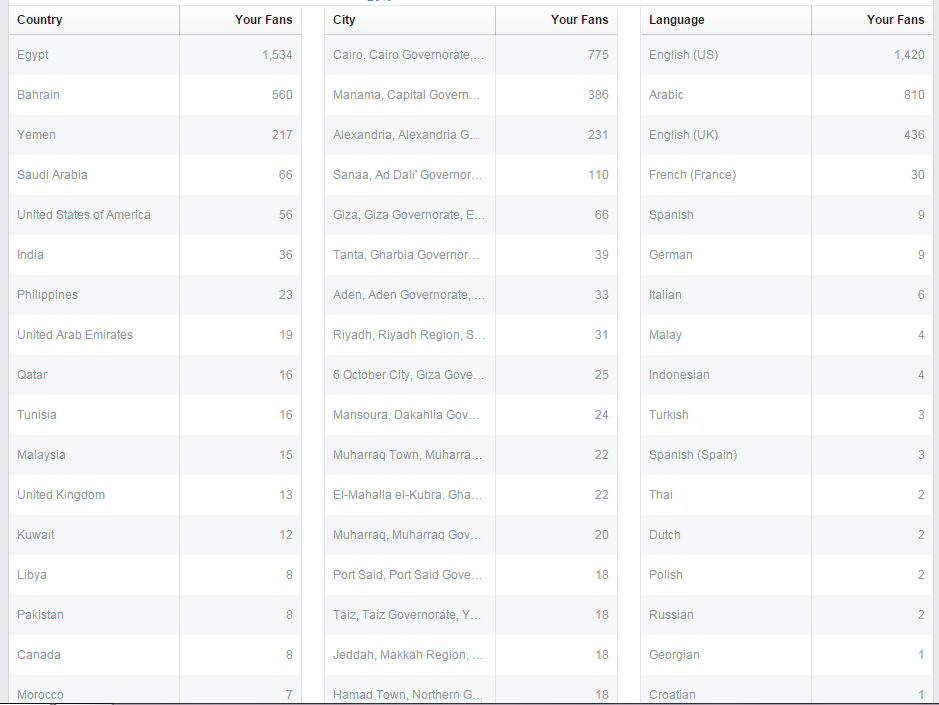
Administrators can also see the country and city fans are from. Most of the fans (as you can see in the picture above) are from Egypt. More specifically, 775 fans are from Cairo, Egypt. In addition to location, Facebook breaks down what language fans speak. 1,114 of people who like the Freedom songs page, speak English.
Facebook pages are valuable because they allow for an in depth demographic analysis as well as a better understanding of how many people a page is reaching. Data is collected on people visiting a page, seeing a post by a page, and liking a page. This is helpful because a company does not have to survey their customers personally, but instead use the data Facebook pulls on people that like their company's page.
Subscribe to:
Posts (Atom)