The Parachute way is an alternate way to approach the job hunt that is not just writing a resume and cover letter and sending it out into the world. Instead of focusing on the job market, you think about yourself, who you are, and what you most want to do and then find an organization that matches you. I'm a little unsure about this method because it is so different than the traditional job hunting method.
Instead of waiting for the company to have a vacancy, you should approach the company through a person who knows both you and the company, regardless of whether they're actually hiring or not.
It's worth a try in my opinion, even if it's hard to find your true following. You could end up finding a job that you absolutely love for years upon years to come, and that's pretty incredible.
Sunday, October 18, 2015
Thursday, October 15, 2015
Achieving Credibility on the internet, Is it all about Aesthetics?
Achieving credibility on the internet is just as complicated than achieving credibility in person. In a way however, achieving credibility between the two are very similar. A Stanford study by Stanford Web Credibility Research found that design of a website had the highest affect on credibility. Aesthetics are very important when it comes to websites. This applies to the real world because if you do not look presentable or like you "fit" whatever job or idea you are presenting, it's much harder to gain an audiences trust. If I saw a person dressed as bozo the clown discussing astrophysics, I would be very confused. Table 1 below shows other parts of a digital website that affect its credibility. The actual content of the website including motive of the company and information are the next important part. In the grand scheme of things, Aesthetics superficially of the website and the way content is presented are important in a consumers experience with a website.
(Fogg et al., 2003).
I think it's worth pointing out that at this point in time, this study is indeed a little dated. I would argue that it is still relevant because the extent to which we use the internet has changed, but we still prefer websites that look clean, professional, have good content, and are easy to read.
If would like to reference the full article,
Tuesday, October 13, 2015
LinkedIn- Yes, It can help you meet people and find a job!
LinkedIn can be applied both to an individual hunting for a job, but also to businesses and brands pushing their products and services. Having a strong individual presence on LinkedIn can also help in establishing a presence for a business or company.
Important things to do on LinkedIn
- build your own network!
- use LinkedIn to aid in finding work
- Create and join LinkedIn groups
- Add examples of projects to expand your LinkedIn portfolio
- make posts and provide updates
Don't abandon your profile on LinkedIn! It's a representation of you and should show your product. If you manage a LinkedIn page for a company, it will likely link to your profile.
One thing to note is that if you're trying to create a LinkedIn profile for a company, you should have an official website and a company e-mail address. LinkedIn also allows for businesses to create advertisements.
The best way to understand LinkedIn is by using it! For that reason, I finally added a profile picture to my LinkedIn and am in the process of updating it and expanding my network.
The best way to keep a LinkedIn account updated and accurate is to schedule time in intervals like once a week for 20 minutes or even 30 minutes a month.
So, go try to make a LinkedIn and see what connections you can find!
A well updated Linkedin should include:
- A summary of who you are
- work experience
- volunteer experience
- Links to projects to create a digital portfolio.
- skills
- connections
- endorsements
So, go try to make a LinkedIn and see what connections you can find!
Monday, October 12, 2015
Advertising on Facebook and Through E-mail
To the people staring at their phones in private and public places,
Cell phone users are everywhere.
Yes, I mean everywhere. I challenge you to walk past a strip mall or restaurants during lunch time and count how many people you see on your cell phones.
A Facebook study found that smartphone users on average spent 2.5 hours every day on their smartphones. The most used application was e-mail followed by Facebook.
I'm not sure how accurate the time spent on smartpohones actually is, but it is important to realize that people are constantly connected to their phones. Smartphones act as alarm clocks, calenders, reminders, a way to communicate quickly, and a way to access the ever growing internet.
That being said reaching potential customers and supporters through Facebook an e-mail can add to a companies marketing campaign.
To reach a company through Facebook, you can make an advertisement for a small cost. Read more about how to do that here. This blog will focus more on the analysis of when one has actually created an add and is beginning to get clicks.
This figure from the ad manager dashboard shows that my advertisement spent its lifetime limit of $5 and ran between Oct 6th- 11th with a focus of clicks per minute. It was also targeted towards the United States, China, and India with a demographic that had interests in social media marketing and social media.
This is a breakdown of the total clicks and reach of my advertisement by age and gender. My add reached and was clicked on mostly by young people between the ages of 13-17 years old and predominately more men clicked on my add than women. I reached 10,504 people, but only 48 of those people actually clicked on the advertisement and followed the link to my website.
The problem with Facebook is that once you create the advertisement and get people to visit your page, you can't really control if your new fans are actually receiving your content. You can however, link a mailing list to your Facebook page or website. If people subscribe to the list, your content will be delivered directly to their e-mail list. MailChimp is a great way to do this. This doesn't necesarily mean a person is reading what you e-mail, but the content is delivered to the person's mailbox.
Cell phone users are everywhere.
Yes, I mean everywhere. I challenge you to walk past a strip mall or restaurants during lunch time and count how many people you see on your cell phones.
A Facebook study found that smartphone users on average spent 2.5 hours every day on their smartphones. The most used application was e-mail followed by Facebook.
I'm not sure how accurate the time spent on smartpohones actually is, but it is important to realize that people are constantly connected to their phones. Smartphones act as alarm clocks, calenders, reminders, a way to communicate quickly, and a way to access the ever growing internet.
That being said reaching potential customers and supporters through Facebook an e-mail can add to a companies marketing campaign.
To reach a company through Facebook, you can make an advertisement for a small cost. Read more about how to do that here. This blog will focus more on the analysis of when one has actually created an add and is beginning to get clicks.
This figure from the ad manager dashboard shows that my advertisement spent its lifetime limit of $5 and ran between Oct 6th- 11th with a focus of clicks per minute. It was also targeted towards the United States, China, and India with a demographic that had interests in social media marketing and social media.
By clicking on breakdown and changing it to by country, I can see that all of my clicks came from India. That is also where my add had the largest reach. I purposely chose to add India and China just to see what would happen. I did not think it would skew my reach so heavily towards India and China. My advertisement only reached one person in the United States. This does show that it is important to tailor your advertisement towards your ideal audience. If you want to reach mainly people in the United States, be careful about adding other countries.
The problem with Facebook is that once you create the advertisement and get people to visit your page, you can't really control if your new fans are actually receiving your content. You can however, link a mailing list to your Facebook page or website. If people subscribe to the list, your content will be delivered directly to their e-mail list. MailChimp is a great way to do this. This doesn't necesarily mean a person is reading what you e-mail, but the content is delivered to the person's mailbox.
Thursday, October 8, 2015
How active should a company be on social media?
Social media seems to revolve around the idea of getting more followers and deciding what and how much to share with your followers. Social media frequency strives to find how often posts should be made on social media. I admittedly try to keep a distance from social media in my personal life and don't post too often. That being said this is a caveat when posting-- it's hard to tell how many people your posts are actually reaching. Moreover, posting too often could lead to saturation with diminishing returns.
An article on by buffer you can find here attempts to quantify how much we should be posting on social media. It seems to be a common theme that posting on social media consistently is important.
I'm a little skeptical about the suggestions for ideal number of posts per day. The stats are interesting, but they are also from 2013 they also seem to focus on top brands and companies. Buffer's best practices include a certain amount of posts until engagement with an audience begins to drop and taper out. I feel like this in theory sounds like a good starting point, but it might not be as applicable to a completely new company as it does to an already established company. Companies also begin to see diminishing returns after a certain amount of posts. For example in a 2012 study by Track Social, researchers found that after three tweets engagement begins to decrease.
I like that all of the data to find frequency of social media and it's effects is so readily available, but I feel like in some cases maybe variables need to be controlled for a little more to avoid confounding factors. In this article there is some detail about the methods and parameters used, but not all that much.
In my opinion it comes down to finding out what works for ones company. There is no single or proper way to do social media. If there was, we would all be experts. In reality, the world is always changing and so is social media. It's unrealistic to be one person and have pages on all platforms that are kept active and up to date. It's more important to find out what platforms work to best reach your audience and what's the optimal activity level for your specific audience.
An article on by buffer you can find here attempts to quantify how much we should be posting on social media. It seems to be a common theme that posting on social media consistently is important.
I'm a little skeptical about the suggestions for ideal number of posts per day. The stats are interesting, but they are also from 2013 they also seem to focus on top brands and companies. Buffer's best practices include a certain amount of posts until engagement with an audience begins to drop and taper out. I feel like this in theory sounds like a good starting point, but it might not be as applicable to a completely new company as it does to an already established company. Companies also begin to see diminishing returns after a certain amount of posts. For example in a 2012 study by Track Social, researchers found that after three tweets engagement begins to decrease.
I like that all of the data to find frequency of social media and it's effects is so readily available, but I feel like in some cases maybe variables need to be controlled for a little more to avoid confounding factors. In this article there is some detail about the methods and parameters used, but not all that much.
In my opinion it comes down to finding out what works for ones company. There is no single or proper way to do social media. If there was, we would all be experts. In reality, the world is always changing and so is social media. It's unrealistic to be one person and have pages on all platforms that are kept active and up to date. It's more important to find out what platforms work to best reach your audience and what's the optimal activity level for your specific audience.
Friday, October 2, 2015
Dreaded Job Interviews
As a senior in college, entering the real world strikes images of resumes,cover letters, and perhaps the scariest part, job interviews. It's not necessarily because job interviews are scary, but because intelligently talking about oneself in a professional manner can be hard!
In Chapter 4 of Richard Bolles' book, What Color is Your Parachute? he gives various advice to job hunters embarking on the interview process including:
- A friendly reminder that while amidst in the job hunt, you're going to hear NO, NO, NO, NO, NO, NO, and NO many times before you here YES, YOU HAVE THE JOB!
- Go on interviews having researched the company. Look at their website, search newspaper databases for mentions of the company your interviewing with, and ask family and friends if they know anyone who works at the company. Know what the company does and what you're getting yourself into, which honestly is a good idea with anything you chose to pursue in life.
- Honor agreements between you and your prospective employer
- Realize that both you and the prospective employer are collecting data on each other. You both have to decide if you like each other, it is not a one sided event. 50% of the talking should be you, the other 50% should be the prospective employer. This being said, make sure you feel like you will like the company before you start marketing yourself.
- Expect to be asked to "Tell me about yourself." Answer this open ended question tactfully. Answer with what kind of experiences, skills, or knowledge,that are relevant to the job you are interviewing for. Have this answer summarized and well rehearsed. It's your elevator speech.
- 5 questions that may be approached in various forms are
- Why are you here?
- What can you do for us?
- What kind of person are you?
- What distinguishes you from the other people applying for this job?
- Can we as a company afford you?
- Appear presentable
- avoid nervous mannerisms like avoiding eye contact, a bad handshake, slouching, or fiddling with your hair.
- show confidence while interviewing ( Yes, I know, easier said than done)
- Be nice to everyone and thank the employer before leaving.
- Remember employers are trying to predict your future behavior and how it relates to their company.
- e-mail and send a hand-written thank you note
Thursday, October 1, 2015
Facebook Advertisements
Facebook adds are an useful marketing tool and can be used to advertise a blog, website, or Facebook page.
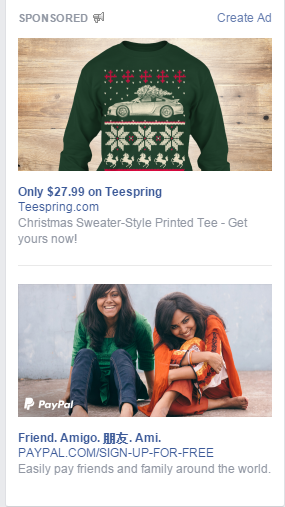
Facebook adds can appear in one's news-feed directly or on the right side of the Facebook page.
An advertisement that appeared directly in my news feed
An advertisement that was on the right side of my Facebook news-feed
Facebook as mentioned in previous posts, provides data! This holds true with their advertising options. You can see how many people the add was displayed to (reach), how many people actually clicked on the add, the click through rate ( percent of people who clicked the add out of total), The extra data may be interesting, but what's really important is how many people are clicking on the advertisement. As a marketer, you want people to see the add, and follow the link to find more information about the product. If no one is clicking on your advertisement, you are not getting any return on investment.
You can also make multiple adds and use Facebook data to figure out which adds are more effective.
Who is your audience? A central idea of marketing is finding a target market. Facebook ads can be targeted towards a particular audience, where theoretically they should perform better. In order to target an audience, chose people who express an interest related to what you're advertising. For example, an ecology blog may be geared to people who have shown at interest in natural sciences.
The fun stuff is actually creating the campaign.
Facebook adds can appear in one's news-feed directly or on the right side of the Facebook page.
An advertisement that appeared directly in my news feed
An advertisement that was on the right side of my Facebook news-feed
Facebook as mentioned in previous posts, provides data! This holds true with their advertising options. You can see how many people the add was displayed to (reach), how many people actually clicked on the add, the click through rate ( percent of people who clicked the add out of total), The extra data may be interesting, but what's really important is how many people are clicking on the advertisement. As a marketer, you want people to see the add, and follow the link to find more information about the product. If no one is clicking on your advertisement, you are not getting any return on investment.
You can also make multiple adds and use Facebook data to figure out which adds are more effective.
Who is your audience? A central idea of marketing is finding a target market. Facebook ads can be targeted towards a particular audience, where theoretically they should perform better. In order to target an audience, chose people who express an interest related to what you're advertising. For example, an ecology blog may be geared to people who have shown at interest in natural sciences.
The fun stuff is actually creating the campaign.
- Go to www.facebook.com/advertising
- Click create add
- Choose what kind of results you want to receive depending on what kind of add you are making. Page likes (with adds linking to Facebook pages) and clicks to external websites are likely to stay consistent and relevant overtime even as Facebook changes)
- Follow the prompt to enter your website or page you want to advertise
- Identify your audience through location, age, gender, language, and interests. The interest sections allows to really hone in on one specific audience.
- Fill out your account and campaign information. This is where you disclose your country, currency, time zone, advertisement schedule and budget over time. Set a start and end date so to your campaign! This gives you a dollar amount as to how much you're spending on a campaign
- Facebook bidding allows for Facebook to bid on on adds for you.If you select optimize for clicks, facebook will choose add placement that gets you the most clicks and you're price you pay may go up or down depending on how many clicks you get.
- You can upload an image for ads. These can be digital images or images made in Photoshop. Content continues to be important in marketing!
- Select a headline and text for your advertisement
- Choose if you add appears to desktop users and mobile users
- Monitor your campaign over time with Facebook's provided analysis
Subscribe to:
Posts (Atom)